

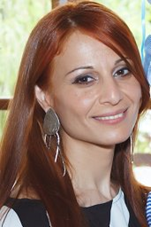
Maria Pavlou
- Theological School of the Church of Cyprus
1-7 Isocratous, 1016, Nicosia, Cyprus - Τel: 22443057
- Fax: 22443050
- Email: m.pavlou@theo.ac.cy
Profile:
Dr Maria Pavlou is Assistant Professor of Ancient Greek Language and Literature at the Theological School of the Church of Cyprus(TSCC), where she teaches in both the Undergraduate and Postgraduate Programmes of Theology. She is also responsible for the School’s Public Relations, Quality Assurance and the Welfare Office.
Dr Pavlou read Classics at the Aristotle University of Thessaloniki (BA, 2002) and the University of Leeds (MA, 2003). She received her PhD from the University of Bristol, UK (2007) with a thesis entitled “Time in Pindar”. She subsequently obtained an MSc in Digital Education from the University of Edinburgh (2018). She also holds Diplomas in Management and Online Education.
From 2005 onwards she has worked as a Teaching Fellow / Adjunct Lecturer at the University of Bristol (2005-2009), the University of Cyprus (2014-2018), and the Open University of Cyprus (2010-2013 & 2018). She has also participated in several research projects at the University of Cyprus (2010-2011) and the Open University of Cyprus (2012-2015).
She has been awarded several prestigious scholarships and fellowiships: Center for Hellenic Studies (Harvard University), Μargo Tytus Summer Fellowship (University of Cincinnati), National Scholarship Foundation of Greece (IKY), A. G. Leventis Foundation, Αrts and Humanities Research Council (U.K.), Fondation Hardt (Geneva), J. Costopoulos Foundation.
She is the author of more than fifty articles and reviews published or forthcoming in academic peer-reviewed journals, collective volumes and conference proceedings. She is the editor of The Dairy Culture of Cyprus: History, Traditions, Folklore(Nicosia: Cyprus Food and Nutrition Museum, 2021) and the co-editor of Debating with the Eumenides (Cambridge Scholars 2018; with Prof. Vayos Liapis and Prof. Antonis Petrides) and Framing the Dialogues: How to Read Openings and Closures in Plato (Brill, 2020; co-edited with Prof. Antonis Tsakmakis and Dr Eleni Kaklamanou). Her book Μέγας Βασίλειος και Ελληνική Παιδεία: Πρὸς τοὺς νέους ὅπως ἂν ἐξ ἑλληνικῶν ὠφελοῖντο λόγων. Εισαγωγή, Μετάφραση, Σχόλια (σ. 368) [Basil the Great and Greek Paideia: Address to the Youth on how to derive benefit from Greek Literature. Introduction, Translation, Commentary, p. 368], was published in 2024 by ENNOIA Publications, Athens.
Dr Pavlou is actively involved in a range of outreach activities aimed at promoting Classics, culture and social solidarity:
- In 2019 she enrolled the TSCC in the Festival Européen Latin Grecand organized several readings of Iliadic passages in 4 different languages (Greek, Arabic, Hebrew, Turkish) and in the Cypriot and Cretan dialects, both by students of the TSCC and by well-known Greek-Cypriot and Turkish-Cypriot poets and actors. In addition to the official readings that took place on 22 March 2019 at the TSCC and were open to the general public, she also organized an unofficial reading of a selection of Iliadic passages at a nursing home.
- In 2020 she designed and coordinated with Dr Chrysanthi Demetriou a Classical Languages Summer School (the first ever in Cyprus), which hosted 25 students from 14 different countries (https://www.theo.ac.cy/first-classical-languages-summer-school-july-2020/).
- During the pandemic she designed and implemented an initiative titled “Online gatherings of love and solidarity” (Διαδικτυακές Συναντήσεις Αγάπης), which sought to facilitate contact between elderly individuals and people with disabilities, on the one hand, and schools, on the other, by providing the participating groups with an online platform for interaction and communication (https://www.theo.ac.cy/διαδικτυακές-συναντήσεις-αγάπης/). The initiative was awarded the Gold Metal (Catergory: Interaction with Society) at the Cyprus Boussias Education Leaders Awards in 2022.
- From April 2022 to May 2023 she coordinated the Erasmus+ Project (K2) AUGE (Αdvancing Utterly Green Environments), which sought to inform and raise the awareness among Primary and Secondary school students about environmental issues, climate change, and renewable forms of energy, with particular emphasis on sustainable and responsible resource management. One of the Project’s goals was the development of educational material on environmental topics, including, among other things, ancient Greek myths with ecological themes, as well as activities designed to familiarise students with the ancient Greek names of animals and birds (https://augeproject.com).
- Google Scholar https://scholar.google.com/citations?user=mJGIj6UAAAAJ&hl=en
- Academia Edu https://theo.academia.edu/DrMariaPavlou
- ResearchGate https://www.researchgate.net/profile/Maria_Pavlou2/research